




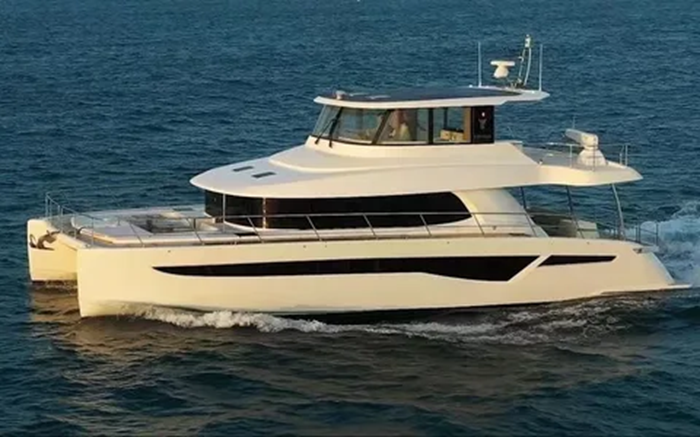
A power catamaran is a vessel with two parallel hulls connected by a common platform, where the propulsion system is designed for confident motorized movement without the need for a sail rig.
This format is increasingly chosen for family trips, charters, and long-distance voyages because it combines spaciousness, stability, and predictable performance on the water.
In rental and purchase practices, a catamaran is considered an alternative to a monohull motor yacht: with a similar level of comfort, it typically offers more usable space and less “sea rolling” at anchor. This is especially noticeable in popular vacation regions and charter destinations, including search queries like yacht rentals miami.
Key Distinctions of Power Catamarans
The main design difference is the twin-hull design, which determines both seaworthiness and layout. A catamaran’s wide hull spacing, shallow draft, and wide deck width create both advantages and limitations.
Hull, Draft, and Handling
- A shallow draft allows for closer approach to shore, entry into shallow bays, and confident anchorage.
- Two engines (often one per hull) provide high maneuverability: turning on the spot and precise mooring become easier.
- Width improves stability, but requires consideration of dimensions when choosing a marina and the cost of berth.
Layout and Usable Space
Due to their wide platform, power catamarans offer more space in the saloon and on the flybridge/cockpit. The hulls conveniently accommodate cabins with separate bathrooms, and the central section often becomes a fully-fledged “living room” with panoramic views.
Wave Behavior
A catamaran rolls less, which is important for those sensitive to pitching. However, on short, steep waves, impacts can be felt in the area of the bridge between the hulls, so when choosing, it’s worth paying attention to the bridge clearance, the shape of the bows, and the actual load of the vessel.
Summary: Twin-hull configuration and informed choice
A motor catamaran differs from a monohull vessel primarily in its twin-hull design: two narrow hulls connected by a bridge deck create different hydrodynamics, weight distribution, and wave behavior. This offers distinct advantages in stability, usable space, and energy efficiency, but also imposes requirements on operation, mooring, and the choice of waters.
When choosing, it’s important to consider the scenario rather than “better/worse” considerations: if space, stability, and fuel efficiency are priorities, a catamaran usually wins; if versatility in tight spaces, ease of maintenance, and familiar handling are more important, a monohull may be more practical.
Key differences worth checking before buying
- Stability and comfort: a catamaran heels less and often reacts more smoothly to side waves; a monohull can “rock” more, but sometimes handles short headwaters more predictably.
- Space: a catamaran has more usable deck and saloon area for a comparable length; A monohull’s width is limited by one hull.
- Draft: Catamarans often have a shallower draft, which is convenient in shallow water; monohulls often have a greater draft for equal length and displacement.
- Efficiency: Two narrow hulls may require less power at cruising speeds; the final efficiency depends on the weight, load, hull type, and the selected speed.
- Maneuverability: Two engines on a catamaran provide precise turns on the spot and convenient mooring; a monohull is often simpler in design, but may require more skill in wind conditions.
- Width and berthing: A catamaran is wider – this is important for marina space, transportation, and berthing costs; A monohull fits more easily into standard dimensions.
- Operation and Repair: A catamaran has more components (two hulls, two drives, more systems), which can increase maintenance requirements; A monohull is usually simpler and cheaper to maintain given the same class.
- Determine the modes of use: cruising, fishing, family outings, long passages, overnight stays on board.
- Compare the water area: wave height, wind frequency, shallow water, presence of narrow passages and berthing areas.
- Evaluate the logistics: berth width, storage conditions, lifting ashore, transportation.
- Conduct sea trials: compare behavior on waves, noise level, visibility, maneuvers at low speed.
- Check the layout and safety: access to engines, pumps and compartments, bulkheads, handrails, the height of the railings and ease of movement.